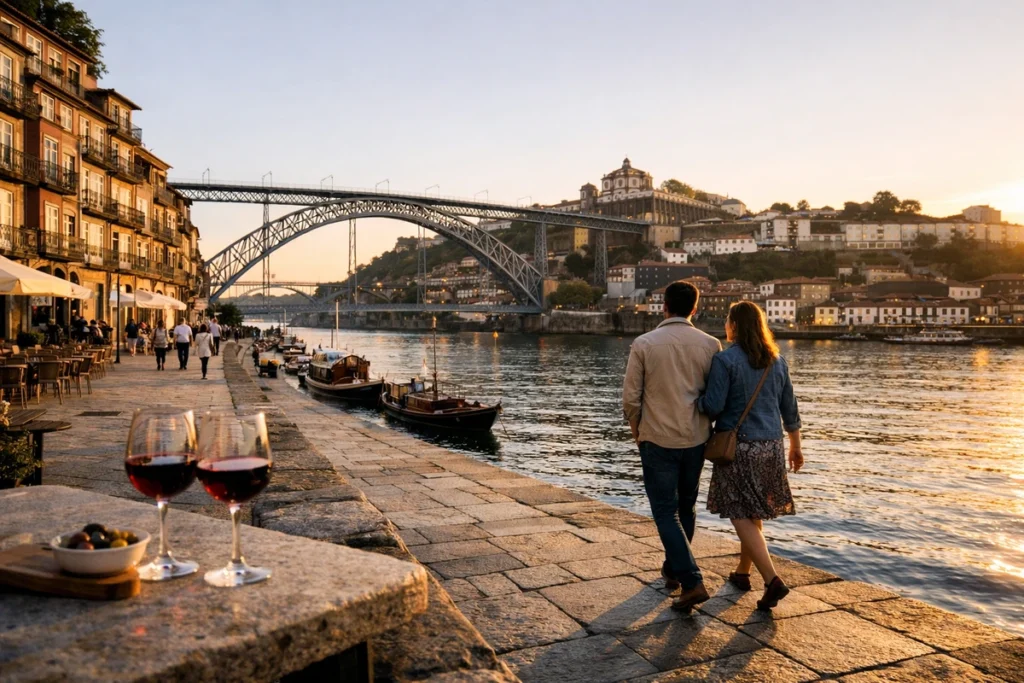
Portugal’s smaller historic towns are where walking feels most natural: compact centres, fewer “must-see” pressures, and an easy rhythm built around small squares, churches, and quiet cafés. This guide shows you how to plan a self-guided cultural walk—with three examples (Évora, Coimbra, Guimarães) designed for a relaxed 1–2 hour loop.
- At a Glance: Cultural Walks in Portugal’s Historic Towns
- Why small towns work so well on foot
- How to plan a self-guided walk (without a guide)
- Three relaxed walk examples
- Small details that make self-guided walks feel premium
- Ready to Plan Your Historic Town Walk in Portugal?
- FAQ: Self-Guided Cultural Walks in Portugal’s Historic Towns
- More City Walks Guides in Portugal
At a Glance: Cultural Walks in Portugal’s Historic Towns
- Best for: slow travellers, culture lovers, photographers, short-stay planners
- Ideal walk duration: 1–2 hours (add time for interiors and tastings)
- Pacing rule: one “anchor” monument + one viewpoint (optional) + one café pause
- How to use this guide: copy the template, then adapt it to any historic town
To keep this guide genuinely useful (and consistently premium), we curate self-guided walks in Portugal’s historic towns using a small set of non-negotiables—focused on compact routes, high cultural reward, and a slow rhythm that suits smaller places.
- Pace First (The Real Luxury): We prioritise walks that feel calm—short loops (1–2 hours) with natural pauses, so you experience atmosphere and details without rushing or “covering ground.”
- Old Town Flow (Not a Checklist): Routes are built as simple “chapters” of the town—main square → landmark → quieter streets → café pause—so the walk feels intuitive and cohesive, not like ticking off pins on a map.
- One Hero Moment, Not Five: Each walk centres on one standout cultural anchor (temple, university quarter, castle, cathedral). Everything else is optional texture—so the day stays light and enjoyable.
- Views & Interiors With Minimal Friction: We favour easy viewpoints and one meaningful interior rather than stacking both. The aim is maximum reward with minimal extra walking, queues, or backtracking.
- Coffee (or Wine) Stops That Fit the Town: We prioritise pauses that feel natural—quiet squares, terrace tables, traditional cafés—so the walk is defined by comfort and local rhythm, not “must-do” stops.
- Clarity & Flexibility: Each route is easy to shorten or extend. We keep start/end points intuitive, suggest the best time of day for light and crowd levels, and include simple pacing guidance—so you can explore confidently, without a guide, and stay unhurried.
This guide is curated on merit. We select hotels and retreats based on research, reputation, and the quality of the guest experience—not on paid placement. Recommendations cannot be bought, and inclusion is never guaranteed in exchange for compensation.
Some links in this article may be partner or affiliate links. If you choose to book through them, we may earn a small referral benefit—at no extra cost to you. This does not influence which properties are featured, how options are described, or how we rank what stands out.
Why small towns work so well on foot
Big cities often push you into multi-stop days and longer distances. Historic towns are different: the centre is usually walkable in a single loop, and the “reward” is atmosphere—stone streets, small museums, local life—rather than constant transit.
How to plan a self-guided walk (without a guide)
1) Choose one clear theme
Pick one lens for the walk so decisions are easy:
- Roman + medieval layers (Évora)
- University + old town streets (Coimbra)
- Medieval squares + birthplace identity (Guimarães)
2) Build your route around two anchors
- Anchor A: your main monument (cathedral / university / castle)
- Anchor B: your “slow moment” (café, garden, riverside bench)
Everything else is optional detail in between.
3) Keep the loop short and intuitive
A good self-guided walk has:
- a simple start point (main square)
- an easy finish (back near the start, or at a transport/taxi point)
- one optional micro-detour (viewpoint or quieter street)
4) Use a simple pacing structure (the luxury version)
- 0–15 min: orientation + first streets (no rushing)
- 15–60 min: monuments + slow wandering between them
- 15–25 min: seated pause (coffee, water, or a small glass of wine)
- last 15–30 min: finish the loop gently
5) Decide in advance what you won’t do
This is what keeps the walk calm. Choose either:
- a major interior (library/church), or
- a viewpoint climb
Not both, unless you’re extending beyond 2 hours.
Three relaxed walk examples
Évora (Alentejo): Roman stones + calm medieval streets
Évora’s historic centre is a UNESCO World Heritage site, shaped by centuries of layers and still compact enough to feel “walkable, not busy.”
Best time: early morning or late afternoon (Alentejo heat is real in summer)
Ideal duration: 1–2 hours (plus interiors)
Start: Praça do Giraldo
Loop idea (easy + cultural):
- Wander the lanes toward Évora Cathedral (choose one interior visit if you want it).
- Continue to the Roman Temple (often referred to as the “Temple of Diana”).
- Drift back via smaller streets, aiming for a quiet café pause near the centre.
- Optional final stop: Chapel of Bones if you want one memorable interior (adds time).
Keep it relaxed
- Treat the Roman Temple as your visual anchor, not a long stop.
- If you visit one interior (cathedral or chapel), skip extra detours.
Coimbra (Centro): university heights + river calm
Coimbra’s UNESCO-listed university area sits above the old town—so the walk naturally has a gentle climb, followed by an easy unwind by the river.
Best time: late morning into afternoon (finish with a riverside pause)
Ideal duration: 1–2 hours (plus booked interiors)
Start: lower old town (near the main pedestrian streets)
Loop idea (chaptered, not rushed):
- Walk upward through the old town toward Sé Velha and the university area (Alta).
- Spend time in the University of Coimbra surroundings—this is your main “cultural chapter.”
- Optional interior: Biblioteca Joanina (timed entry is common; plan this as your one major interior).
- Descend at an easy pace and finish with a Mondego river pause (sit, reset, people-watch).
Keep it relaxed
- If you do the library, keep everything else lighter: one viewpoint, no extra climbs.
- Use the river as your “slow luxury” finish.
Guimarães (Minho): medieval squares + castle calm
Guimarães’ historic centre (now including the Couros zone) is UNESCO-listed, and it’s made for short, high-reward wandering: granite lanes, lived-in squares, and a clear castle chapter.
Best time: morning or late afternoon (soft light on stone streets)
Ideal duration: 1–2 hours
Start: Largo da Oliveira
Loop idea (classic, unhurried):
- Begin in Largo da Oliveira and nearby squares—this is your atmosphere-first stretch.
- Walk the medieval streets toward Guimarães Castle (short climb, strong reward).
- Optional: add the Palace of the Dukes of Braganza if you want one interior/museum stop.
- Return via a different lane back to Largo da Oliveira for a café pause.
Keep it relaxed
- Do either castle + palace, or castle + extra slow wandering—don’t overload the hour.
- Let the squares be the highlight; they’re the town’s natural “pause points.”
Small details that make self-guided walks feel premium
- Start earlier than you think: the first hour is quieter and more photogenic.
- Sit once on purpose: a 15–20 minute pause changes the whole pace.
- Choose one “hero moment”: a temple, a library, a castle—then stop adding tasks.
- Wear shoes that handle stone: cobblestones + slopes are part of the charm.
Ready to Plan Your Historic Town Walk in Portugal?
Build a 1–2 hour loop you’ll actually enjoy: start in the main square, choose one cultural “anchor” (a cathedral, castle, or university chapter), then wander the quieter lanes between small pauses—coffee, a shaded terrace, or a simple local sweet. These walks are designed to feel natural and unhurried—more atmosphere than agenda.
FAQ: Self-Guided Cultural Walks in Portugal’s Historic Towns
Share this guide